

CCNA 4 Chapter 2 2020 Edition Answers. Get all of the validated answers for the CCNA 4 Chapter 2 2020 Edition Answers. Ideal for quick and fast review or getting ready for the actual test. if you have short time then you are on right place.
CCNA 4 Chapter 2 2020 Edition Answers
This is the CCNA 4 Chapter 2 2020 editon with 100% correct answers:
Q1. Which three are types of LCP frames used with PPP? (Choose three.)
- link-establishment frames
- link-control frames
- link-negotiation frames
- link-termination frames
- link-acknowledgment frames
- link-maintenance frames
Link-establishment frames establish and configure a link. Link-maintenance frames manage and debug a link. Link-termination frames terminate a link.
Q2. Which command can be used to view the cable type that is attached to a serial interface?
- Router(config)# show ip interface brief
- Router(config)# show ip interface
- Router(config)# show interfaces
- Router(config)# show controllers
The show controllers command will allow an administrator to view the type of cable attached to a serial interface such as a V.35 DCE.
Q3. How does PPP interface with different network layer protocols?
- by using separate NCPs
- by encoding the information field in the PPP frame
- by specifying the protocol during link establishment through LCP
- by negotiating with the network layer handler
PPP can support multiple network layer protocols, such as IPv4, IPv6, IPX, and AppleTalk. It handles the interface with various network layer protocols via separate NCPs. There is a protocol field in a PPP frame to specify the network layer protocol that is being used. The information field in a PPP frame is the data payload. LCP sets up and terminates a link. It does not check which network layer protocol is used for the data.
Q4. Which address is used in the Address field of a PPP frame?
- a single byte of binary 10101010
- a single byte of binary 11111111
- a single byte of binary 00000000
- the IP address of the serial interface
Because PPP is point-to-point, it does not need to assign individual station addresses. The Address field in the frame is a single byte of binary sequence 11111111, the standard broadcast address.
Q5. Which field marks the beginning and end of an HDLC frame?
- FCS
- Data
- Control
- Flag
An HDLC frame consists of six or more fields. Two Flag fields are used to mark the beginning and the end of the frame.
Q6. In which situation would the use of PAP be preferable to the use of CHAP?
- when router resources are limited
- when multilink PPP is used
- when a network administrator prefers it because of ease of configuration
- when plain text passwords are needed to simulate login at the remote host
There are times when PAP should be used instead of CHAP. When a plain text password is needed to simulate login at a remote host, PAP is preferable, since passwords are not sent in clear text with CHAP.
Q7. When configuring Multilink PPP, where is the IP address for the multilink bundle configured?
- on a physical serial interface
- on a multilink interface
- on a physical Ethernet interface
- on a subinterface
When configuring a PPP multilink bundle, the IP address will be configured on the multilink interface, not on the physical interface. This is because the multilink bundle is representing two or more physical interfaces.
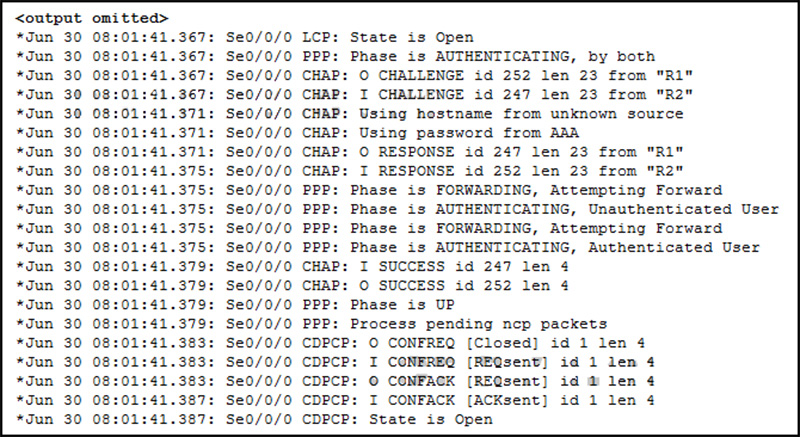
Q8. Refer to the exhibit. Based on the debug command output that is shown, which statement is true of the operation of PPP.
- A PPP session was successfully established.
- CHAP authentication failed because of an unknown hostname.
- Both PAP and CHAP authentication were attempted.
- The debug output is from router R2.
This debug output is from router R1 and shows that a PPP session was successfully established. Success can be verified by the line of output with CDPCP: State is open.
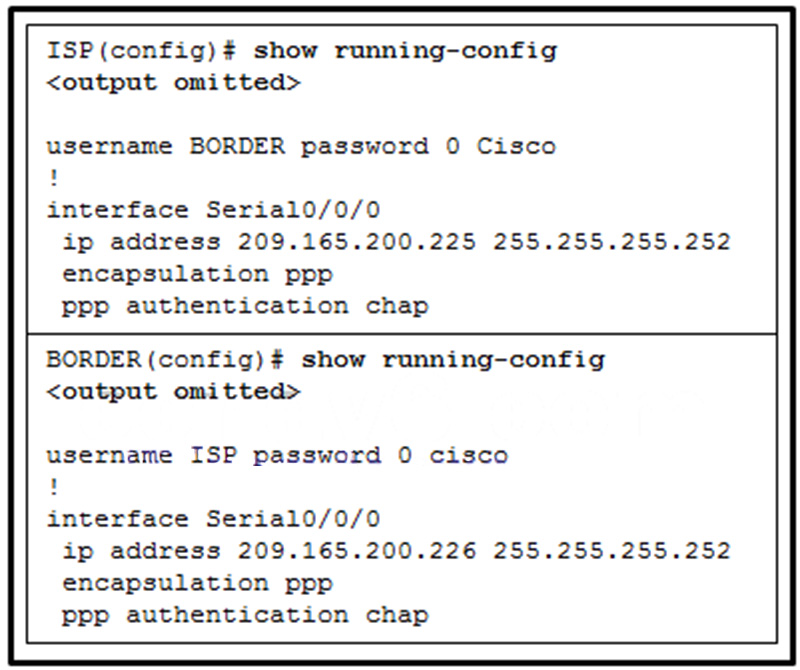
Q9. The exhibit has two boxes. The first box shows the following partial command output:
Refer to the exhibit. A network administrator is configuring the PPP link between the two routers. However, the PPP link cannot be established. Based on the partial output of the show running-config command, what is the cause of the problem?
- The usernames do not match.
- The passwords should be longer than 8 characters.
- The interface IP addresses are in different subnets.
- The passwords do not match.
In PPP authentication, the passwords are case sensitive and must match on both sides.
Q10. Which protocol will terminate the PPP link after the exchange of data is complete?
- IPXCP
- NCP
- LCP
- IPCP
LCP terminates a link after exchange of data is complete by exchanging link-termination packets. The link may terminate for various reasons before the data exchange is complete. NCP will only terminate the network layer and NCP link. IPCP and IPXCP are specific network control protocols.
Q11. Which serial 0/0/0 interface state will be shown if no serial cable is attached to the router, but everything else has been correctly configured and turned on?
- Serial 0/0/0 is up, line protocol is up
- Serial 0/0/0 is up (looped)
- Serial 0/0/0 is up (disabled)
- Serial 0/0/0 is up, line protocol is down
- Serial 0/0/0 is down, line protocol is down
- Serial 0/0/0 is administratively down, line protocol is down
The show interfaces privileged exec mode command shows the state of the interfaces, along with much other information that related to them. “Serial 0/0/0 is down, line protocol is down” is displayed if there is no cable connected because there is no Layer 1 or Layer 2 activity going on. The interface has been turned on by the use of the no shutdown command, otherwise the “Serial 0/0/0 is administratively down, line protocol is down” message would be displayed, whether a cable has been connected or not.
Q12. How much total bandwidth is provided by a T1 line?
- 64 kb/s
- 1.544 Mb/s
- 128 b/s
- 43.736 Mb/s
A T1 line consists of 24 voice channels with 64 kb/s each of bandwidth. This gives a T1 link a total bandwidth of 1.544 Mb/s.
Q13. A network engineer is monitoring an essential, but poor quality, PPP WAN link that periodically shuts down. An examination of the interface configurations shows that the ppp quality 90 command has been issued. What action could the engineer take to reduce the frequency with which the link shuts down?
- Set the DCE interface to a lower clock rate.
- Use the bandwidth command to increase the bandwidth of the link.
- Issue the command ppp quality 100.
- Issue the command ppp quality 70.
Issuing the ppp quality 70 command will reduce the link quality threshold before it shuts down from 90% of packets received that were sent, to a drop rate of 70% before shutting down. Setting the threshold to 100% will shut down the link if 100% of packets are not received. Lowering the clock rate will not help a link that is going down. The bandwidth command is used for routing protocol calculations, not link quality.
Q14. A network engineer is troubleshooting the loss of MPEG video viewing quality as MPEG video files cross a PPP WAN link. What could be causing this loss of quality?
- Link Quality Monitoring was not configured correctly on each interface.
- PAP authentication was misconfigured on the link interfaces.
- The clock rates configured on each serial interface do not match.
- The compress command was used when PPP was configured on the interfaces.
Using the compress command when configuring PPP on interfaces can reduce the system performance due to a software compression process. The reduced performance may reduce the content delivery quality, especially in the case of audio and video streaming, such as MPEG file streaming. When compressed data files, such as .mpeg, .zip, and .tar files, are carried on the link, using the compress command is not recommended. If PAP is used but misconfigured, the PPP link will not work at all. The clock rate is needed only on the DCE side of a serial link. Configuring Link Quality Monitoring will only monitor the incoming and outgoing link quality. Link Quality Monitoring is not sensitive to which type of content is transmitted.
Q15. Which PPP option can detect links that are in a looped-back condition?
- Callback
- Magic Number
- ACCM
- MRU
A Magic Number is randomly generated by PPP at each end of the connection. This number is used by the devices at each end to detect a looped-back condition.
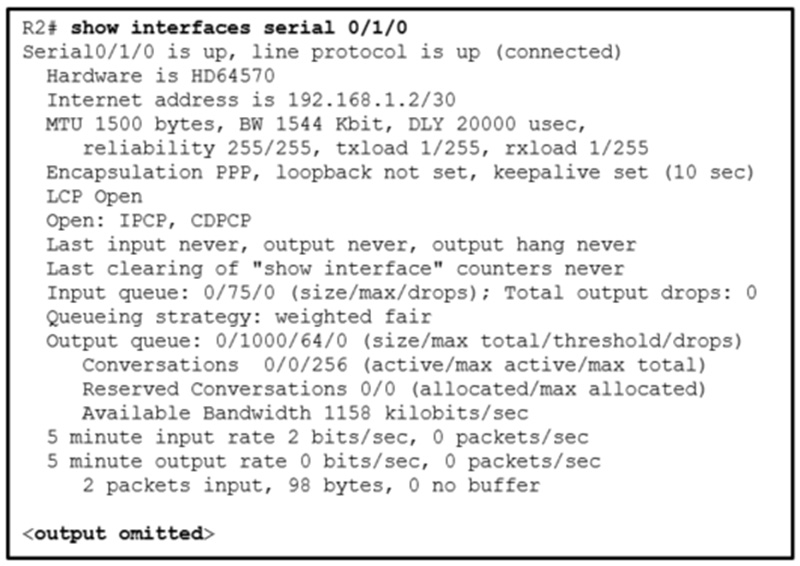
Q16. Refer to the exhibit. A network engineer has issued the show interfaces serial 0/0/0 command on a router to examine the open NCPs on a PPP link to another router. The command output displays that the encapsulation is PPP and that the LCP is open. However, the IPV6CP NCP is not shown as open. What does the engineer need to configure to open the IPV6CP NCP on the link?
- Configure CHAP authentication on each router.
- Issue the compress predictor command on each interface on the link.
- Configure PPP multilink interfaces on each router.
- Configure an IPv6 address on each interface on the link.
The PPP IPV6CP NCP will open when the interface on each router is configured with an IPv6 address.
Q17. Which three physical layer interfaces support PPP? (Choose three.)
- synchronous serial
- FastEthernet
- Ethernet
- GigabitEthernet
- asynchronous serial
- HSSI
PPP can operate across any DTE/DCE interface in either asynchronous or synchronous bit serial mode. The high-speed serial interface (HSSI) developed by Cisco Systems and T3 plus Networking is a DTE/DCE interface that provides high speed connectivity. Asynchronous serial interfaces and synchronous serial interfaces are also DTE/DCE interfaces.
Q18. What are three components of PPP? (Choose three.)
- authorization
- NCP
- HDLC-like framing
- LCP
- parallel communications
- support for LAN and WAN
PPP is a WAN protocol to provide serial point-to-point connections. The three main components of HDLC include the Network Control Protocol (NCP), an extensible Link Control Protocol (LCP), and framing similar to HDLC.
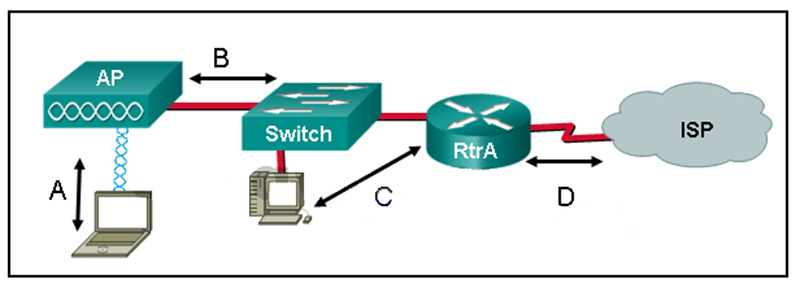
Q19. Refer to the exhibit. What type of Layer 2 encapsulation will be used for connection D on the basis of this configuration on a newly installed router:
RtrA(config)# interface serial0/0/0
RtrA(config-if)# ip address 128.107.0.2 255.255.255.252
RtrA(config-if)# no shutdown
- PPP
- Ethernet
- HDLC
- Frame Relay
HDLC is the default encapsulation method on Cisco router serial interfaces. If no other encapsulation is configured, the interface will default to HDLC.
Q20. Which two statements describe a PPP connection between two Cisco routers? (Choose two.)
- LCP tests the quality of the link.
- LCP manages compression on the link.
- NCP terminates the link when data exchange is complete.
- With CHAP authentication, the routers exchange plain text passwords.
- Only a single NCP is allowed between the two routers.
PPP uses LCP to perform the functions of establishing, configuring, and testing the data-link connections on the link as well as negotiating encapsulation, authentication, and compression formats.
Q21. Open the PT Activity. Perform the tasks in the activity instructions and then answer the question.
Why is the serial link between router R1 and router R2 not operational?
- The encapsulation in both routers does not match.
- The authentication type is not the same in both routers.
- The passwords are different in both routers.
- In each case the expected username is not the same as the remote router hostname.
The hostname in one router must be the same as the username in the other router, unless a username is specified with the ppp pap sent-username interface command.
Q22. Match the PPP option with the correct description. (Not all options are used.)
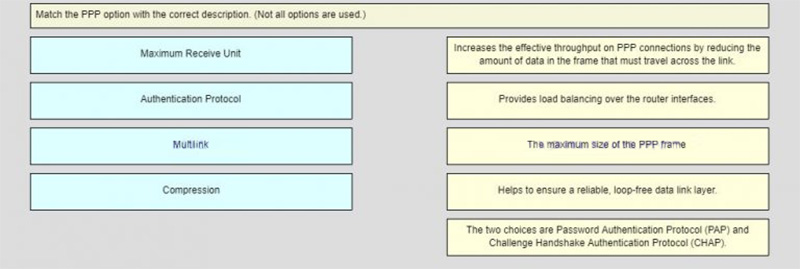
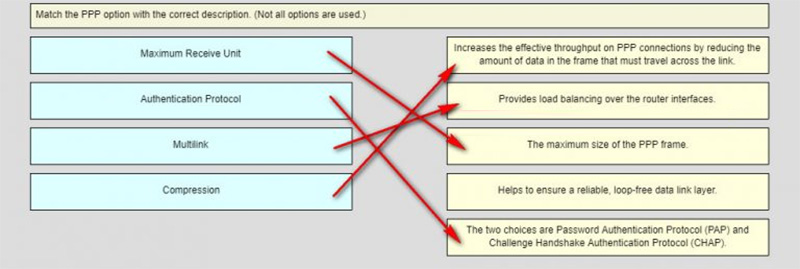
Place the options in the following order:
Maximum Receive Unit => The maximum size of the PPP frame
Authentication Protocol => The two choices are Password Authentication Protocol (PAP) and Challenge Handshake Authentication Protocol (CHAP).
Multilink => Provides load balancing over the router interfaces.
Compression => Increases the effective throughput on PPP connections by reducing the amount of data in the frame that must travel across the link.
Q23. Match the phases of establishing a PPP session in the correct order. (Not all options are used.)
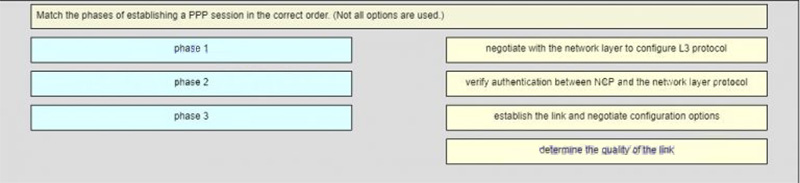
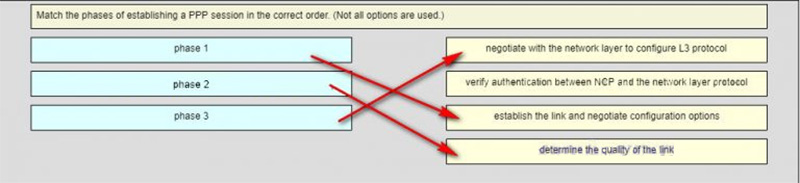
Place the options in the following order:
phase 1 => establish the link and negotiate configuration options
phase 2 => determine the quality of the link
phase 3 => negotiate with the network layer to configure L3 protlcol
The first two steps happen at Layers 1 and 2. Once the link is established and configured, link quality can be determined before layer 3 configuration takes place.
Q24. Match the steps to the PPP CHAP authentication process sequence. (Not all options are used.)
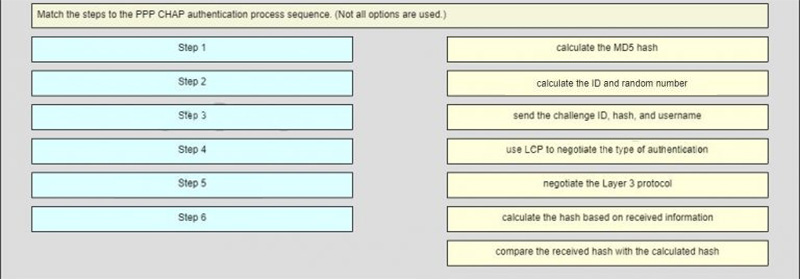
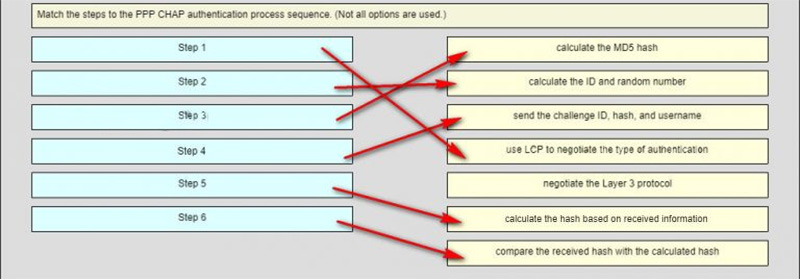
Place the options in the following order:
Step 1 => use LCP to negotiate the type of authentication
Step 2 => calculate the ID and random number
Step 3 => calculate the MD5 hash
Step 4 => send the challenge ID, hash, and username
Step 5 => calculate the hash based on received information
Step 6 => compare the received hash with the calculated hash
Q25. Which is an advantage of using PPP on a serial link instead of HDLC?
- fixed-size frames
- higher speed transmission
- option for authentication
- option for session establishment
Authentication, multilink, and compression are options on PPP that are advantages over HDLC.
Older Version
Q26. A small company with 10 employees uses a single LAN to share information between computers. Which type of connection to the Internet would be appropriate for this company?
- a dialup connection that is supplied by their local telephone service provider
- Virtual Private Networks that would enable the company to connect easily and securely with employees
- private dedicated lines through their local service provider
- a broadband service, such as DSL, through their local service provider
Q27. Which network scenario will require the use of a WAN?
- Employee workstations need to obtain dynamically assigned IP addresses.
- Employees need to connect to the corporate email server through a VPN while traveling.
- Employees in the branch office need to share files with the headquarters office that is located in a separate building on the same campus network.
- Employees need to access web pages that are hosted on the corporate web servers in the DMZ within their building.
Q28. Which two devices are needed when a digital leased line is used to provide a connection between the customer and the service provider? (Choose two.)
- access server
- CSU
- Layer 2 switch
- DSU
- dialup modem
Q29. What are two advantages of packet switching over circuit switching? (Choose two.)
- The communication costs are lower.
- There are fewer delays in the data communications processes.
- Multiple pairs of nodes can communicate over the same network channel.
- A dedicated secure circuit is established between each pair of communicating nodes.
- A connection through the service provider network is established quickly before communications start.
Q30. What is a requirement of a connectionless packet-switched network?
- Each packet has to carry only an identifier.
- The network predetermines the route for a packet.
- Full addressing information must be carried in each data packet.
- A virtual circuit is created for the duration of the packet delivery.
Q31. What is a long distance fiber-optic media technology that supports both SONET and SDH, and assigns incoming optical signals to specific wavelengths of light?
- ISDN
- MPLS
- ATM
- DWDM
Q32. What are two common high-bandwidth fiber-optic media standards? (Choose two.)
- ANSI
- ATM
- ITU
- SDH
- SONET
Q33. What is the recommended technology to use over a public WAN infrastructure when a branch office is connected to the corporate site?
- ATM
- ISDN
- municipal Wi-Fi
- VPN
Q34. What is a feature of dense wavelength-division multiplexing (DWDM) technology?
- It replaces SONET and SDH technologies.
- It enables bidirectional communications over one strand of fiber.
- It provides Layer 3 support for long distance data communications.
- It provides a 10 Gb/s multiplexed signal over analog copper telephone lines.
Q35. Which WAN technology establishes a dedicated constant point-to-point connection between two sites?
- ATM
- ISDN
- leased lines
- Frame Relay
Q36. Which WAN technology is cell-based and well suited to carry voice and video traffic?
- ATM
- ISDN
- VSAT
- Frame Relay
Q37. Which two technologies use the PSTN network to provide an Internet connection? (Choose two.)
- ATM
- ISDN
- MPLS
- dialup
- Frame Relay
Q38. A company needs to interconnect several branch offices across a metropolitan area. The network engineer is seeking a solution that provides high-speed converged traffic, including voice, video, and data on the same network infrastructure. The company also wants easy integration to their existing LAN infrastructure in their office locations. Which technology should be recommended?
- VSAT
- ISDN
- Frame Relay
- Ethernet WAN
Q39. A customer needs a WAN virtual connection that provides high-speed, dedicated bandwidth between two sites. Which type of WAN connection would best fulfill this need?
- circuit-switched network
- Ethernet WAN
- MPLS
- packet-switched network
Q40. Which WAN connectivity method would be used in a remote location where there are no service provider networks?
- cable
- VPN
- VSAT
- WiMAX
Q41. A home user lives within 10 miles (16 kilometers) of the Internet provider network. Which type of technology provides high-speed broadband service with wireless access for this home user?
- 802.11
- municipal Wi-Fi
- DSL
- WiMAX
Q42. Which connectivity method would be best for a corporate employee who works from home two days a week, but needs secure access to internal corporate databases?
- cable
- DSL
- VPN
- WiMAX
Q43. Which wireless technology provides Internet access through cellular networks?
- satellite
- municipal WiFi
- LTE
- WiMAX
Q44. Which geographic scope requirement would be considered a distributed WAN scope?
- local
- one-to-one
- one-to-many
- many-to-many
- regional
- global
Q45. A new corporation needs a data network that must meet certain requirements. The network must provide a low cost connection to sales people dispersed over a large geographical area. Which two types of WAN infrastructure would meet the requirements? (Choose two.)
- public infrastructure
- private infrastructure
- Internet
- dedicated
- satellite
Q46. Match the type of WAN device or service to the description. (Not all options are used.)
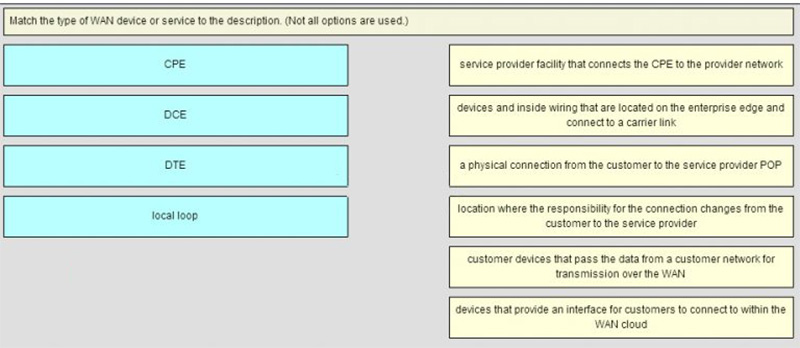
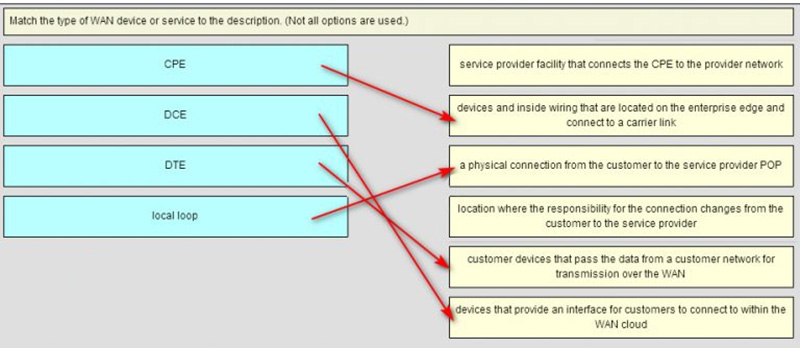
Place the options in the following order:
— not scored —
CPE -> devices and inside wiring that are located on the enterprise edge and connect to a carrier link.
LOcal Loop -> a physical connection from the customer to the service provider POP
— not scored —
DTE -> customer devices that pass the data from a customer network for transmission over the WAN
DCE -> devices that provide an interface for customers to connect to within the WAN cloud
Q47. Match the connectivity type to the description. (Not all options are used.)
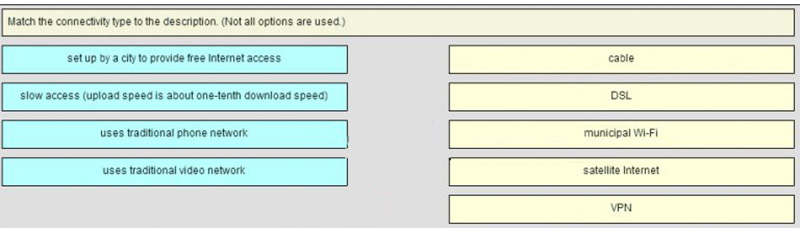
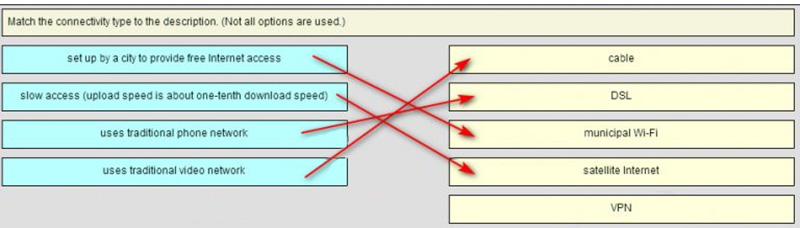
Place the options in the following order:
uses traditional video network -> cable
uses traditional phone network -> DSL
set up by a city to provide free Internet access -> Municipal Wi-Fi
slow access (upload speed is about one-tenth download speed) -> Satellite Internet
– not scored –
Q48. Which statement describes a characteristic of a WAN?
- A WAN provides end-user network connectivity to the campus backbone.
- A WAN operates within the same geographic scope of a LAN, but has serial links.
- WAN networks are owned by service providers.
- All serial links are considered WAN connections
Q49. Which feature is used when connecting to the Internet using DSL?
- CMTS
- IEEE 802.16
- LTE
- DSLAM
Q50. Which equipment is needed for an ISP to provide Internet connections through cable service?
- access server
- CSU/DSU
- DSLAM
- CMTS
Q51. Which solution can provide Internet access to remote locations where no regular WAN services are available?
- VSAT
- WiMAX
- Ethernet
- municipal Wi-Fi
Q52. A corporation is looking for a solution to connect multiple, newly established remote branch offices. Which consideration is important when selecting a private WAN connection rather than a public WAN connection?
- lower cost
- higher data transmission rate
- website and file exchange service support
- data security and confidentiality during transmission
Q53. Which statement describes cable?
- Delivering services over a cable network requires downstream frequencies in the 50 to 860 MHz range, and upstream frequencies in the 5 to 42 MHz range.
- The cable subscriber must purchase a cable modem termination system (CMTS).
- Each cable subscriber has dedicated upstream and downstream bandwidth.
- Cable subscribers may expect up to 27 Mbps of bandwidth on the upload path.
Q54. What is an advantage of packet-switched technology over circuit-switched technology?
- Packet-switched networks are less susceptible to jitter than circuit-switched networks are.
- Packet-switched networks can efficiently use multiple routes inside a service provider network.
- Packet-switched networks do not require an expensive permanent connection to each endpoint.
- Packet-switched networks usually experience lower latency than circuit-switched networks experience.
Also Read: CCNA 4 Chapter 1 2020 Edition Answers
Note: If you have the new question on this test, please comment Question and Multiple-Choice list in form below this article. We will update answers for you in the shortest time. Thank you! We truly value your contribution to the website.